Market update for realtor partners — September 8, 2026
There’s a lot of noise right now about interest rates and central banks, so I wanted to get ahead of the questions you may be getting from clients. The U.S. Federal Reserve announces its next rate decision on Wednesday, September 16. Below is our read on what’s likely to happen and, more importantly, what it means for Canadian mortgage rates. I want to stress that this is our opinion, not a certainty. Feel free to forward this to any client who’s watching the headlines.
The short version
We expect the U.S. Fed to raise its rate by 0.25%. Counterintuitively, we think that would be good news for Canadian fixed mortgage rates in the near term. Here’s why.
Two different rates, two different drivers
Most people assume central banks set mortgage rates. They only set one of them.
- Variable rates follow the Bank of Canada. The Bank held its rate at 2.25% on September 2, so prime stays at 4.45% and variable-rate payments don’t change.
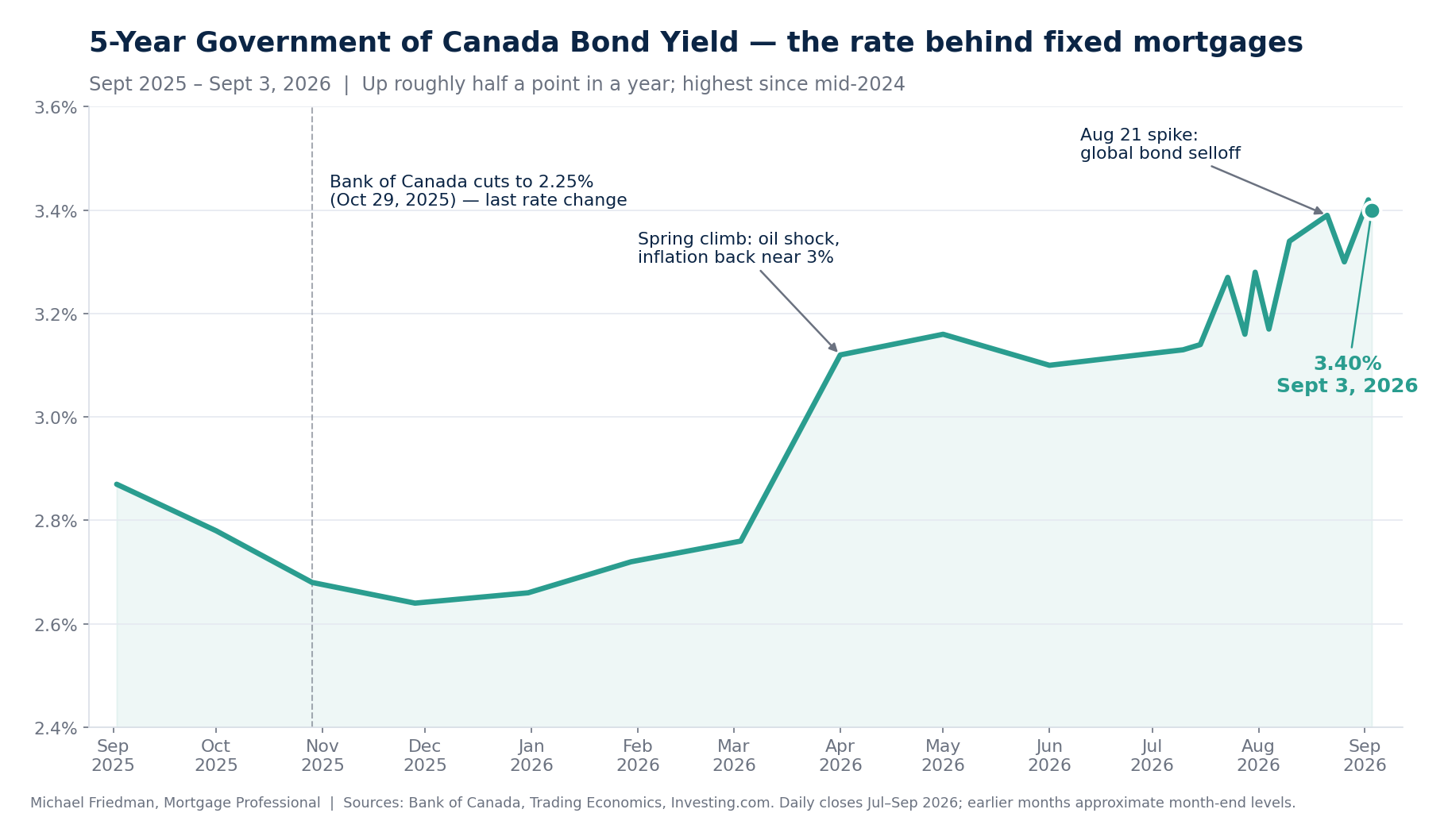
- Fixed rates follow the bond market. A 5-year fixed mortgage is priced off the 5-year Government of Canada bond, and that bond trades every day alongside U.S. Treasuries and other global government debt. When U.S. yields rise, Canadian yields tend to follow, and fixed mortgage rates follow them.
That second point is why fixed rates have been creeping up all summer even though the Bank of Canada hasn’t moved. The 5-year Canada bond has climbed from about 2.7% in late February to around 3.4% today, and the U.S. 10-year Treasury has gone from roughly 4.0% to about 4.8%, its highest level in about three years.
Why would a U.S. Fed hike help?
Bond investors worry about inflation, especially with oil prices elevated because of the conflict in the Middle East. When the U.S. Fed held rates in July despite three of its own committee members voting for a hike, the bond market read that as the Fed being soft on inflation, and long-term yields moved up, not down.
The logic is simple: if investors believe the central bank won’t fight inflation, they demand a higher return to lend money for five or ten years. If the Fed acts, that inflation worry eases, and long-term yields can fall even as the U.S. Fed’s short-term rate rises. In plain terms, a Fed hike would tell the bond market, “we’ve got this,” and the bond market is what prices your client’s fixed rate.
The flip side is also worth knowing: if the U.S. Fed doesn’t hike next week, bond yields are more likely to rise further and fixed rates to tick up again.
What this means for your clients
- Buyers or renewals leaning toward a fixed rate: A “Fed raises rates” headline is not the bad news it sounds like. It may be what finally takes pressure off fixed rates. Anyone with a live file should have a rate hold in place regardless, because the reaction could go either way on the day.
- Clients in a variable rate: A U.S. Fed hike doesn’t change the Canadian prime, but it does slightly raise the odds that the Bank of Canada follows later this year. A couple of the big banks are already forecasting a move to 2.75% by year-end. Variable is still cheaper today, but the gap is narrowing, and that’s worth a conversation.
- Everyone else: The one honest answer to “should I wait for rates to fall?” is that the floor under fixed rates has moved higher this year, and waiting has been a losing bet since February. We’ll know more Wednesday afternoon.
Rate and bond yield figures are as of September 8, 2026 and may change before the Fed announcement. This update reflects our opinion and is provided for general information only; it is not a rate commitment or advice for any specific situation.