We all know the narrative of the last two years in Greater Vancouver real estate: interest rate shocks, cautious buyers, and a market correcting from historical peaks. If you’ve been on the sidelines waiting for the “bottom,” you’re not alone.
Every client I speak with right now has the same question: “Is now the time to buy, or are prices still dropping?”
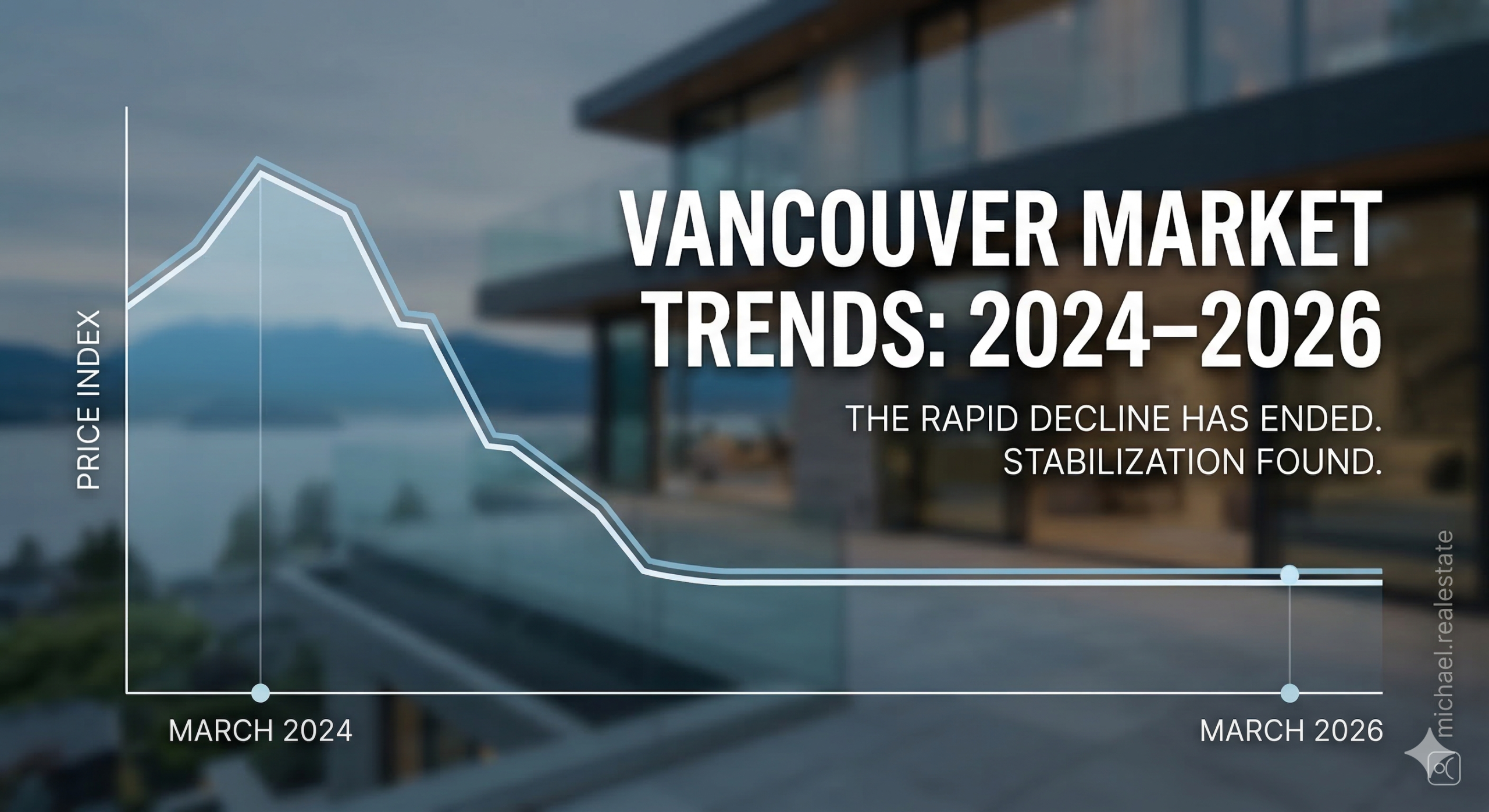
The short answer is: We are likely finding the bottom, but the landing is “sideways,” not V-shaped.
As we move into Spring 2026, the data indicates that while we are unlikely to see a 2021-style spike in prices, the rapid monthly declines are over. We have entered a market plateau.
Here is the data-driven reality of where the Vancouver market stands today.
The 2-Year Trend (2024–2026)
To understand where we are going, we have to look at where we’ve been. Two years ago (Spring 2024), Vancouver was absorbing the fastest rate-hiking cycle in modern history. A significant slowdown defined the following year (2025) as buyers lost borrowing power.
We are now emerging from that correction. Based on the Teranet-National Bank House Price Index and GVR data, the major free-fall phase has concluded.
Key 2-Year Shift: While the benchmark composite price is down approximately 6% to 8% from the late 2023/early 2024 peak, the deceleration of the decline is the real story.
Why the Market is Finding a “Floor” (The Pro-Bottom Case)
I suspect that we have found a bottom that is supported by key metrics of stabilization:
1. The Month-over-Month (MoM) Flattening Year-over-year stats still show negative numbers, but the monthly data shows stabilization. In early 2026, the benchmark composite price declined by only 0.1% month over month. When monthly volatility drops to near zero, it’s a strong signal that a price floor has been established.
2. Interest Rate Stabilization The Bank of Canada’s rate adjustments (and the anticipation of stability through 2026) have removed the fear of further collapse. Buyers now have certainty regarding their borrowing costs, which were absorbed through 2025. This certainty creates a floor.
3. Segmentation Divergence The “market” isn’t monolithic. We are seeing a divergence where affordability creates resilience.
The Reality: It’s a Plateau, Not a Spike
While the rapid declines have stopped, we must acknowledge the factors that keep the market in a “sideways transition” rather than a sharp recovery:
Final Verdict for 2026
The “bottom” is rarely a single date; it is a season, a plateau, or a sideways grind. The Vancouver market in 2026 is defined not by rapid movement in either direction, but by stability and choice.
The window where buyers have massive inventory to choose from—at prices stabilized near the bottom of this cycle—is open now.
Are you trying to time your entry into the Vancouver market? The data changes block by block, so it’s essential to have a professional Realtor by your side to navigate the specifics of your target neighbourhood. If you aren’t currently working with a real estate professional, please reach out—I’d be happy to provide you with a few trusted names to ensure you’re in good hands.